Compare the actual duties and expectations instead of choosing by cause or organization name alone. The goal is not to find a perfect role. It is to find one you can begin safely, complete dependably, and continue for the period you agreed to serve.
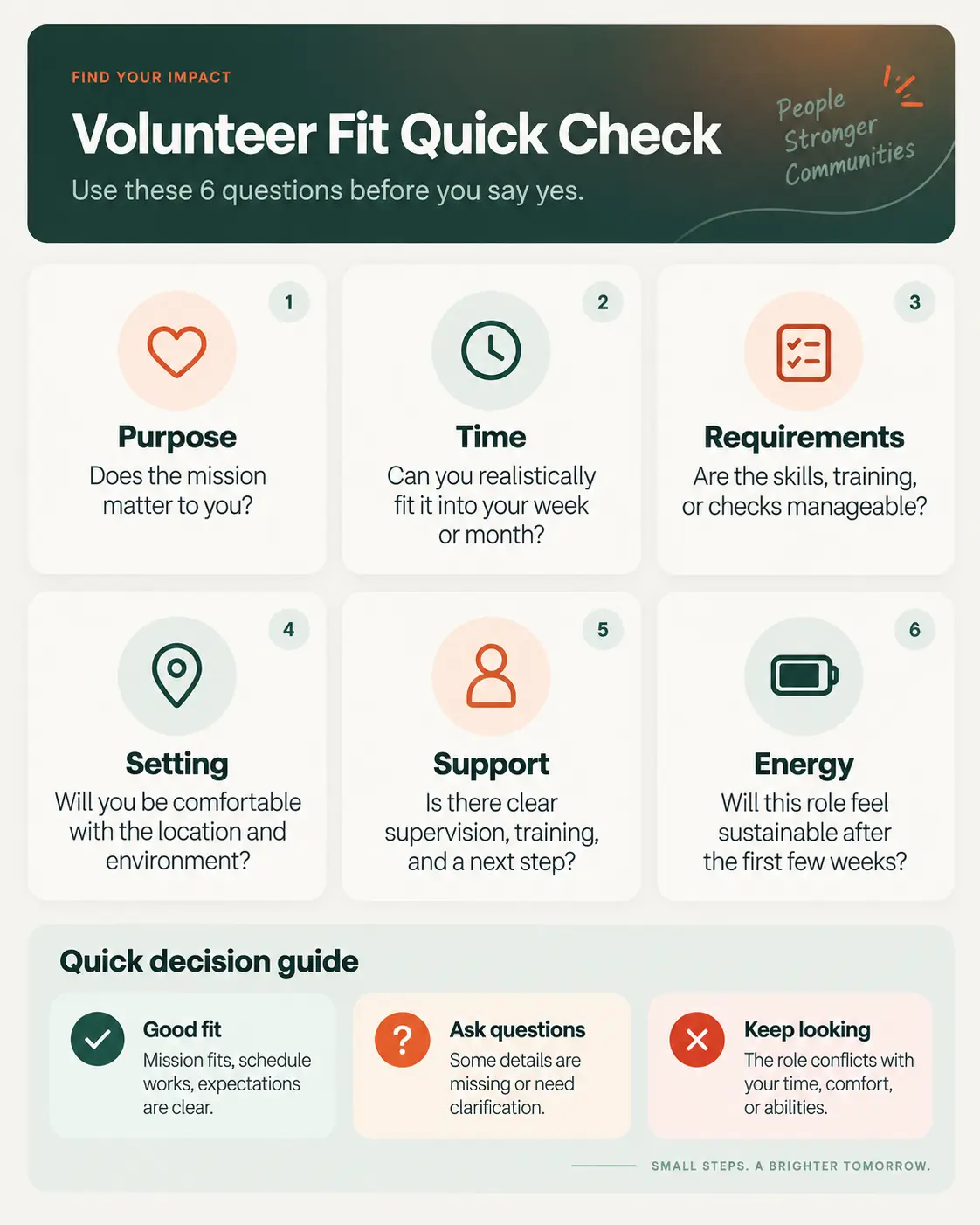
Use six fit questions
A quick comparison across six areas can reveal whether an opportunity deserves a closer look.
One weak area does not always rule out a role. A missing detail may only require a question. A direct conflict with your schedule, age, transportation, accessibility, safety, or required qualifications is different and should be resolved before you commit.
Compare current opportunities
Open several complete listings and compare the duties, schedules, requirements, settings, and next steps side by side.
Understand the work
A cause tells you why the work matters. The task tells you what your time will involve. Two opportunities supporting the same cause can feel completely different.
For example, an animal organization might need kennel cleaning, dog walking, foster care, event help, photography, office support, or transportation. Choose based on the listed tasks, required experience, physical demands, and amount of contact with animals or the public.
Look for a description of a normal shift. If the listing relies on broad phrases such as helping the community without explaining the work, ask for specific examples.
Compare the commitment with your calendar
Pay attention to both the shift length and the duration of the commitment. A two-hour shift may still require weekly attendance for several months. Orientation or training may occur on a separate date.
| Commitment | What it usually means |
|---|---|
| One-time | The role is tied to one shift, event, or project. |
| Ongoing | The organization expects repeated service. |
| Seasonal | The need lasts during a defined period. |
| Flexible | Some scheduling choice is available, but deadlines may still apply. |
Ask how the organization handles cancellations, schedule changes, and time away. If you cannot meet a recurring commitment, a one-time or short-term project may be a better starting point.
Check every requirement
Requirements protect the people served, the organization, and volunteers. They may also determine whether you can start quickly.
- Minimum age or adult supervision
- Application or interview
- Orientation or role-specific training
- Background or driving-record check
- License, certification, or demonstrated skill
- Physical activity or lifting
- Transportation or use of a personal vehicle
- Required clothing or protective equipment
Confirm who pays any screening or equipment cost and when it is due. Do not send sensitive personal information until you understand the organization, its process, and why the information is required.
Consider the setting
The same task can feel different depending on where and how it is performed. Review whether the opportunity is indoors or outdoors, seated or active, public-facing or independent, quiet or busy, and at one location or several.
Consider weather, stairs, standing, lifting, noise, animals, driving, food handling, and contact with the public when those conditions matter to you. Ask about accessibility and possible adjustments rather than assuming that a title describes the setting.
Look for clear supervision and next steps
A strong listing explains how to apply or express interest and gives volunteers a way to ask questions. The organization should be able to identify a contact person or team, explain what happens after an inquiry, and describe the first shift or orientation.
For roles involving minors, vulnerable adults, private information, driving, money, tools, food preparation, or unsupervised access, ask how volunteers are trained and supervised. Requirements will vary by organization and task.
Watch for signs that you need more information
Pause before committing when important facts are missing or inconsistent. A problem may be an incomplete listing rather than a bad organization, but it still needs an answer.
- The duties are vague or change when you ask about them
- The location or schedule is unclear
- The organization pressures you to commit immediately
- The requested personal information seems unrelated to the role
- Costs, transportation, or equipment requirements appear late
- No one can explain training, supervision, or who to contact
- The listing appears expired or conflicts with the official website
Use the correction link on VolunteerCVS when a listing appears outdated, inaccurate, or unavailable. Contact the organization directly when you need clarification about its current procedures.
Contact the organization before saying yes
Use a short message that states the opportunity, your availability, and the information you need. You do not need to write a long personal statement unless the application asks for one.
I am interested in the Saturday pantry volunteer opportunity listed on VolunteerCVS. I am available twice a month and can arrive by 8:30 a.m. Is the role still open, and is orientation required before the first shift?
Keep the organization response with the listing details until you know the date, location, contact person, and next step.
Try a limited commitment when possible
A one-time shift or short project can help you understand the work before accepting an ongoing role. This is useful when you are new to volunteering, testing a new type of task, or unsure how the schedule will fit.
Do not treat a trial shift casually. Arrive prepared, follow instructions, and tell the organization promptly if you decide the role is not a fit. Clear communication helps the organization plan and allows you to leave responsibly.
Make the final decision
Before accepting, confirm that you can answer yes to the points that matter most for this role.
If a role fails a firm requirement, keep looking. Declining before the organization schedules or trains you is better than accepting a commitment you already know you cannot keep.
When a role is not the right fit
Tell the volunteer coordinator as early as possible. Explain the practical conflict without criticizing the cause or organization. When appropriate, ask whether another task, schedule, or location would fit better.
Stop immediately and contact the appropriate organization representative if you believe a situation is unsafe or seriously different from what was described. For emergencies, contact local emergency services. VolunteerCVS can review and correct its listing, but the organization controls on-site operations.
Compare current opportunities
Review the complete opportunity details, then compare duties, schedules, commitments, requirements, settings, and organization information before contacting the organization.
Browse volunteer opportunities →Frequently asked questions
What if I am interested in several causes?
Compare the tasks and schedules first. You may find that the kind of work matters more to your daily experience than the cause label. Save several possibilities and contact the organizations that match your firm requirements.
Should I choose a one-time or ongoing role?
Choose a one-time role when you need schedule flexibility or want to test a type of work. Choose an ongoing role when you can reliably meet the schedule and the program benefits from continuity. Read the stated commitment before applying.
What if the listing does not answer my question?
Contact the organization before committing. Ask one or two specific questions about the missing information. You can also report outdated or incomplete listing information to VolunteerCVS.
Is an approved VolunteerCVS listing guaranteed to be safe?
No directory can guarantee every experience. VolunteerCVS reviews listings for publication, but organizations control screening, training, supervision, facilities, and daily operations. Review the organization and ask questions that matter to your situation.
Can I change volunteer roles later?
Often, yes, but available roles and transfer procedures vary. Speak with the volunteer coordinator if the current work, schedule, or setting is not suitable. Give reasonable notice when the organization depends on you for scheduled service.